
The Basics Of Casino Chip Collecting
Heritage is pleased to present this exciting category to our clients. A relatively new, but fast-growing hobby, casino chip collecting seems to have all the necessary components to continue to grow in popularity. For those who are new to this hobby, we strongly recommend the definitive reference book on the subject, co-authored by our own casino chip consultant, James Campiglia. Look for details on how to order at the conclusion of this introduction.
Chip Value
There are five basic factors that determine the price of a chip. Here is an overview of these factors, in order of importance:
- Rarity: The fewer chips available, the higher the price. This economic reality of supply and demand hasn't changed in thousands of years.
- Location: The most popular location to collect is Las Vegas, Nevada. Therefore, if all things are equal, a chip from Las Vegas is more valuable than a chip from anywhere else. Second best is anything else from Nevada. There is a strong demand to collect one chip from each club or casino be it Nevada, or Deadwood. In general, non-Nevada chips do not have the same demand, but there are exceptions. Also, some casinos are more collectible than others. A famous, historically significant casino like the Flamingo, Sands, Dunes, etc. is much better than an obscure club.
- Aesthetic Appeal: The attractiveness and artistry of a chip has a major impact on the price. Put simply, a chip with a nice picture inlay is far more desirable and valuable than a chip with a simple hot stamp. A chip with an inlay, but not a picture, would be somewhere in between. Of course, a chip with a hot stamped picture is better than one with just hot stamped words. Condition adds to aesthetic appeal.
- Mold: Beginners should not ignore this factor. Serious collectors have definite preferences. The best mold, by far, is the Arodie. Second best are the old crest and seal chips (C&S). Then follow the many Sm-key (small Greek key) as well as Rectl (rectangle), popular molds used in the classic era of chips. Above-average molds are C&J (Christy & Jones), Rcthrt (rectangles and hearts), Diswrl (dice with comet's tail), and HCE (H with rectangle).
- Condition: This is very significant and applies to every chip ever made. Condition has become considerably more important over recent years
Therefore, by using these five factors, it is feasible to arrive at estimates of value for chips that are not commonly sold, or for new discoveries. Theoretically, the most valuable chip would be a unique, NEW condition chip from Las Vegas with an Arodie mold and a great-looking, classic picture from a famous, historically significant casino.
Rarity
The rarity number (e.g. R-9) is the best estimate of the number of surviving chips known to exist. In some cases, the numbers are known precisely, and in other cases, a consensus was reached based on experience, observation, and the opinions of knowledgeable collectors across the country.
One good way to remember this chart is to bear in mind that an R-5 (75-150 chips) is roughly equal to a box of chips. So, if there is definitely less than a box known (75 chips or less), the rarity climbs to R-6, officially the point where a chip becomes "rare." Each time the rarity rating increases one point, the population roughly drops in half. See the chart below.
| Rarity Scale | Known Survivors |
| Unknown: | 0 |
| Unique: | 1 |
| R-10 Impossible: | 2-3 |
| R- 9 Exceedingly Rare: | 4-7 |
| R- 8 Extremely Rare: | 8-15 |
| R- 7 Very Rare: | 16-30 |
| R- 6 Rare: | 31-75 |
| R- 5 Very Scarce: | 76-150 |
| R- 4 Scarce: | 151-350 |
| R- 3 Fairly Common: | 351-750 |
| R- 2 Common: | 751-2000 |
| R-1 Extremely Common: | 2000+ |
Note: "Unknown" chips are confirmed to have been manufactured and used on the tables, but no surviving examples are known to exist.
Issue
This is the chronological order in which we feel that the chips were issued. Significant research was done to try and unlock this mystery. In most cases, the accuracy is very high; but some issues of some clubs are very difficult, if not impossible to determine. Occasionally, new discoveries cause and issue change, but this is rare enough not to cause any serious confusion.
Grading
- Grading Descriptions or Standards are a result of natural use of chips and tokens. The following five grades have been adopted and endorsed by the Casino Chips & Gaming Tokens Collectors Club: New, Slightly Used, Average, Well Used, and Poor.
- New: Never used in games: square and round edge chips will be as from the manufacturer with absolutely no wear; no dings or nicks; no scratches on surface of chip or inlay.
- Slightly Used: Only slight signs of use: edge still crisp but ever so slightly dulled with very little wear; cross hatching may show slight wear near edge; few or no edge nicks; still retains luster in mold design; bold hot stamp; inlays excellent.
- Average: Typical chip found in play after months or years of use: slightly rounded edges; will have minor defects such as small nicks on edges; inlays are beginning to show even wear and about half of the cross hatching has worn from the body surface; hot-stamps have dulled, beginning to show even wear and may be missing a small amount of foil.
- Well Used: Moderate and uniform wear of edge, surface, and hot stamp; noticeable edge nicks and/or surface scratches; no luster in mold design; cross hatching is nearly worn off; hot stamp is still readable but much of the foil is missing.
- Poor: Edges that were formerly sharp and square, are now well worn like bicycle tires' original hot stamp foil is mostly missing with only the recesses visible (may have to hold towards a Iight); moderate to large chips (nicks); surface cross hatching barely visible (if at all); severe scratches to inlay of chip surface; severe color fading; partial wear up to half of Chipco design from the edge to the center of the chip. Damage, such as cracks, breaks, missing inlay or other chip structure, do not apply to this category.
-
Condition Descriptions or Standards are unnatural changes in chips as a result of other causes. Specimens in this "condition" category may be graded in any of the five "Grading Descriptions." A cancelled, damaged, or defective chip can be graded in any category from "New" to "Poor." However, a dirty, cracked, or faded chip cannot be graded as NEW, even if it has not been played in a casino. It is not in the original grade as when it was made. The "Condition" category consists of the following terms that should be used as qualifiers to further accurately describe the five grades:
- Cancelled or Modified (either by the manufacturer or the casino): Drilled, Notched, Overstamped, Clipped, Painted.
- Damaged: Severe nicks or chunks, Loose or missing inlay, Cracked, Broken, Warped, Permanent stain, Severe fading, Cigarette burn(s) or fire damage, Over-cleaning (faded dried out look with grainy appearance.)
CC>CC
The Casino Chips and Gaming Tokens Collectors Club is a large national Chip Collecting Club that was founded in 1988. The Club has already enrolled over 7,500 members. Membership has many benefits. Throughout the country, there are many chip clubs; a list is on the CC>CC website.
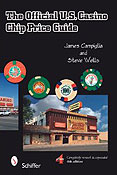 The above information has been adapted from: The Official U.S. Casino Chip Price Guide , Fourth Edition by James Campiglia and Steve Wells (Atglen, Pennsylvania: Schiffer Publishing Ltd., 2009). Heritage is pleased to offer our clients this 4th Edition written by James Campiglia for a special price of $35 postpaid. This book includes images of over 2,100 casino chips with many never before published listings. To be totally up to date on this fast paced hobby, you will want to see these chips from top collections. This book will give you information on grading by CC>CC standards as well as current values. Don't miss this opportunity to add this book to your reference library. Please contact Heritage Client Services at 866-835-3243 to reserve your copy.