
The Legendary Merrill C. Berman Political Collection
Jim Halperin Co-Chairman of Heritage Auctions sees political items as intrinsically appealing, Historically significant and a great area for investment.
Boston native Jim Halperin formed a part-time rare stamp and coin business when he was 16 --- the same year he received early acceptance to Harvard College.
But by the end of his third semester, Halperin was enjoying the coin business more than his studies, so he became a full-time numismatist. In 1982, he entered into a 50/50 partnership with Steve Ivy and together they built Heritage Auctions into the largest collectibles auctioneer in the world.
Over the years, the co-chairman of Heritage Auctions has remained an avid collector.
"I would describe my interests as eclectic," Halperin says. "Special areas of concentration include comic books and original comic art, Maxfield Parrish paintings and prints, art glass, original art nouveau posters, Harriet Frishmuth sculptures, and of course political campaign items. But I've made acquisitions in several other categories when some unseen force ignites a wave of nostalgia or otherwise catches my eye."
Heritage is in the process of auctioning the legendary Merrill C. Berman political collection. This seems to be a good time to ask why you collect in this category.
I guess I first became aware of the political item hobby in 1981, when I ran New England Rare Coin Auctions, before it merged with Steve Ivy's coin company to become Heritage. NERCA handled the auction sale of what was at that time probably the best political collection that had ever come to market, the Don Warner collection. As a longtime devotee of American history, I was captivated by these campaign collectibles. I'd never seen anything like them! As objects, they were colorful and fun. Each one seemed like a portal to the electoral battles of generations past. The timing wasn't right for me to embark on a new hobby, but over the years I often thought wistfully of the fascinating pieces in the Warner collection.

My personal circumstances were very different in 2004 when Heritage acquired an auction firm called Slater's Americana and its proprietor, Tom Slater, arrived in Dallas to build an Americana department for us. Since the 1970s, Tom has been one of the leading dealers and auctioneers of important political campaign artifacts, and this category became one of the mainstays of our Americana sales. That's when I caught the "bug." I've been building a collection ever since.
Among people who appreciate art, antiques and collectibles, it seems there are two camps: those who are content to admire objects in books, exhibits and museums, and those who feel the need to actually possess tangible items. Clearly you fall in the latter category. Why do you think you have that urge to collect?
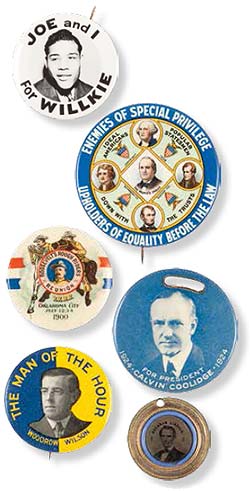
I have focused more and more on my collections as investments because I believe in diversification of assets for financial safety as well as an opportunity for lifelong learning. I see political items as a great area for investment, especially now that the Internet has made them more liquid and easier to research. The objects themselves are both intrinsically appealing and historically significant. They can teach us much about the personalities, political issues and tenor of campaigns past.
What, in your view, has most recently brought attention to this category?
In the early 1990s, the esteemed historian Arthur Schlesinger Jr. was editing a two-volume series of essays by various authors dealing with each American presidential election. His co-editor, University of Pennsylvania professor of history Fred Israel, was himself a leading collector of 19th century political campaign flags, and encouraged him to visit a friend in New Jersey who had amassed one of the most comprehensive collections of campaign items from buttons to banners dating back to George Washington. Schlesinger was reportedly "blown away" by what he saw, and couldn't stop enthusing about how important these artifacts are in illustrating and understanding our political traditions. When their book, Running for President, was published by Simon & Schuster in 1994, it was lavishly illustrated with items from the collection of that New Jersey hobbyist, David J. Frent. Those are wonderful volumes, and although long out of print can still be found for sale on the Internet, and they provide a great introduction to political items in their historical context.
So what's attractive about this category?
The political item market exhibits some intriguing qualities for a collector/investor like me. The historical importance of these pieces assures that there will always be demand for them. This is no passing fad like Beanie Babies! There is already a well-established collector base, anchored by the American Political Items Collectors association, founded in 1945. This organized hobby has created an orderly and stable marketplace for political collectibles. On the whole, prices have risen slowly and relatively steadily. A Cox-Roosevelt jugate button worth $2,000 in the 1970s will fetch around $25,000 today. But it has been estimated that the total annual auction sales for political items in a range of venues still total less than $10 million --- such a tiny market given its obvious appeal. This is a field that seems ripe for rapid rises in value as soon as a significant influx of new collectors occurs.
Another appealing factor is the relative affordability of items in top condition. In all collecting fields a premium is placed on condition --- in some, like coins, sports cards or comic books, on a very dramatic scale. Although this is true of political items as well, the spread in value is surprisingly small. If a given turn-of-the-century political buttons sells for average condition for $500, an absolutely pristine example might fetch $700 or $800. As this collecting hobby matures, that differential seems certain to widen dramatically, especially when one or more grading-certification services inevitably enter the field. So I try to buy only items which are rare, significant and in top condition.
How does one get started collecting campaign memorabilia? Are there comprehensive illustrated price guides or other short cuts to effective collecting?
An excellent place to start would be the Auction Archives at HA.com, which include thousands of political items we have sold, along with enlargeable photos, full descriptions and prices realized. You can easily search for a particular candidate or election or a category such as "political posters" or "women's suffrage movement," and in an instant you will see not only an array of what is available to be collected on that subject, but also get a very good feeling for how much such items will cost.
One of the appealing aspects of political collecting is that you are free to collect what you like. There is no pressure to acquire things you "need" in order to make your collection complete. There is no such thing as collecting for completeness. A legendary collector of Franklin D. Roosevelt memorabilia, the late Joe Jacobs, amassed some 4,000 different pro- and anti-FDR pinback buttons --- and he still didn't have anywhere near all of them! Most collectors these days collect just what appeals to them, building a representative cross section for the various elections and candidates. A few still specialize in a single candidate, or a genre such as political postcards, but most hobbyists just buy what they like and can afford. While the rarest items can cost many thousands of dollars, it is also possible to build an interesting collection without spending more than $100 for any single piece.
[Heritage's director of Americana auctions] Tom Slater has not lost his enthusiasm after nearly 50 years in the political hobby. He never tires of talking about political history and campaign memorabilia, and I know he would be more than happy to speak with anyone who has a serious interest in this fascinating field.
The first auction of the Merrill C. Berman collection took place on Feb. 28, 2015. Items and prices realized can be viewed at HA.com. The second Berman sale is slated for June 27, and will be available for viewing and bidding online around June 10. To request a full-color printed catalog, call 1-800-872-6467 and ask for the catalog order desk.