
Rose Quartz: "La Madona Rosa"
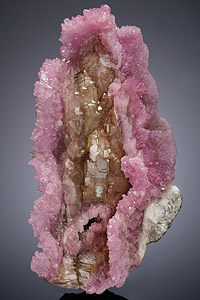 |
The smoky Quartz "body" of the Madonna is an abstract composition of vaguely human form, bearing a multitude of scintillating surfaces. The overall effect is completed by a wide ribbon or "halo" of sparkling Rose Quartz crystals, completely outlining the body of the Madonna and enhancing the resemblance to classical statues and icons. Measuring an impressive 15.5 x 8 inches (39 x 20 cm), it towers over all other known Rose Quartz specimens and stands in a league of its own.
 |
In the late 1950s, miners working a small mine in Brazil, found a miraculous pocket of Rose Quartz: although only six inches wide and 12 inches high, the pocket extended for 16 feet in length. It was filled with deep pink, Rose Quartz crystals draped sinuously over smoky Quartz --- a unique association not seen before, or since.
The miners at "Sapucaia" (the mine's informal name because of its proximity to that town) had hit the jackpot --- Rose Quartz had never been seen before this discovery. Later finds in Brazil also yielded additional Rose Quartz specimens (notably Lavra da Ilha and Alto da Pitora) but none approached the sheer size and beauty of the specimens from Lavra Berilo Branco --- they became the "gold standard" for Rose Quartz. The only other major example known from this historic find, is the "Van Allen Belt" which currently resides in the Smithsonian.
Examination of La Madona Rosa's features leads to the conclusion that, in all likelihood it came from the original "Sapucaia" (Lavra Berilo Branco) discovery. But attempts to pin down the history of this particular specimen break down at a certain point. Some opine that it was produced during the original discovery of 1959 and remained hidden for decades in the collection of a Brazilian gentleman before emerging to the notice of the outside world. Another account states that it was "discovered" in Brazil in 1972 (the mine had been in sporadic operation until 1973). Whatever its origin, it was acquired by a London gemstone collector in 1972. It was sold in 1977 to a U.S. gem collector and resided in that collection for twenty years --- its significance unrecognized for decades.
It surfaced at the 1997 Tucson Gem & Mineral show, where it was recognized for its considerable potential. Modern cleaning and trimming measures were performed and the end result is nothing short of spectacular. It was subsequently sold into the Hoppel Collection and held a central position in that collection --- hidden from public view until now.